Ancient Enemy is really coming together – we’ve added most of the text (story, lore for collectible cards, etc) and we are gradually slotting the enemy graphics into the game.
We’ve pinned down the level content and enemies. This means making decisions about when to introduce game items (like power ups and potions), attaching items of loot to various classes of enemy, and allocating enemies to levels.
As a result we can now show off a fair amount of gameplay! Check out these short battle videos:
Don’t forget that you can find out more about the game and wishlist it here:
I’m writing this from the perspective of being a full-time indie programmer/designer/producer. Basically, I run my own company and I make videogames with the help of contractors and various business partners.
In fact I’ve made 11 games so far and you can wishlist my 12th game, Ancient Enemy, on Steam here: http://bit.ly/AncientEnemy
I’ve been doing this since 2005, so 14 years, and I’d love to continue for a long time because I enjoy the lifestyle and I love making games, but… wow, it is hard to make a living from this.
So anyway, I wanted to explore some numbers so you can see why I think the economics of making indie games and selling them on Steam is wack.
Prerequisites
In order to make indie games full-time you need:
– To know how to program games. Maybe you were a hobbyist for many years (I did that), or learned in a previous job, or went to university to learn (costs money).
– A computer and some kind of programming language or engine, and probably other tools like Photoshop and Dropbox, which require a license fee.
– Somewhere to do the work. Maybe at your house. Some people hire an office (and employees) but I wouldn’t do that unless I had serious cash in the bank. It’s a fast track to disaster in my opinion.
– A company (probably). You can make games as a self-employed person but it’s easier to interact with the various distribution platforms if you own a company. Of course this means doing annual accounts and paying an accountant.
– Some business knowledge. You can’t just dive in and make whatever you want if you want to survive. You will have to analyse the market, come up with a design and a budget, find the right people, manage the project and your money, market the game, and then finally ship it.
– A lot of money in the bank to pay for your living expenses and for 3rd party contractors. OR super-low overheads like living at your parents or having a financially supportive partner or something. That was never really an option for me. Even if you have low overheads you will most likely still have to pay someone for graphics and audio and maybe marketing unless you find someone who will work for revenue share.
Some important formulas
Before we start it’s worth bearing in mind two important numbers:
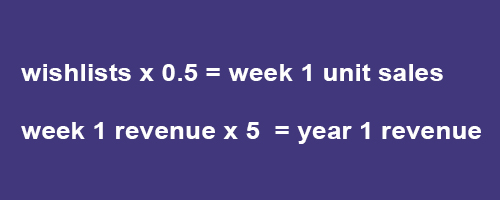
1) If you multiply the number of prelaunch wishlists (on Steam) for your game by 0.5 this will be approximately the number of units you will sell during week 1. Bear in mind some games may do better but many also do worse. It’s still a useful ballpark for calculations.
2) If you multiply your week 1 gross sales revenue (on Steam) by 5, this will approximate to the gross revenue you will make in year 1. That’s assuming a) you keep putting your game on sale at a discount, and b) the game is good enough that the review score is OK and so people aren’t discouraged from buying it. There are other factors too and it’s possible that multiplying by 5 is too high in 2019 and it should be closer to 3. But for now let’s use 5.
Where do those numbers come from? I’ve blogged about them in the past after doing a couple of surveys of a wide range of developers. Also since then many devs have been using those numbers to help predict their sales and have reported back to me with their results, and the formulas seem to be reasonably accurate.
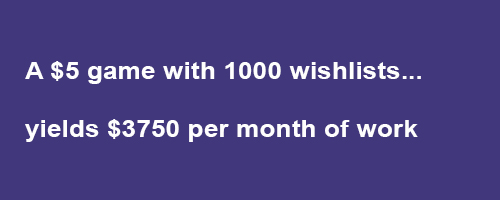
1000 wishlists for a $5 game
OK let’s dive into some numbers. I want to present several different scenarios to make my point.
First off, let’s say you want to make a small arcade/platform game with no external costs (you are using programmer art and free audio and coding the game yourself).
You want to spend two months making the game and sell it for $5 because it’s a small game and you can’t really justify a higher price point.
You manage to get 1000 wishlists for your game. This is actually not at all easy and many indies would struggle to get 100 if they are not already well-known or do not have an existing fanbase or are not amazing at marketing.
Using the formulas from above you could expect 500 sales in week 1 which is $2500 gross. If you can afford to sit around and wait for a whole year, that could be as high as $12,500 gross.
After Steam’s 30% cut and other deductions including refunds, you will probably get about 60% of that money, which is $12,500 x 0.6 = $7500 (~£5770).
So that’s about $3750 of revenue per month of work. Maybe that sounds OK to you but it’s not enough to cover my bills for my family of four.
Furthermore, in order to keep that going you’d have to put out a new game EVERY two months without a break and without going back to support the old games and without illness or vacations or family issues etc. Also every game would have to conform to my formula above and not flop. So, good luck with that…
Don’t forget 1000 wishlists is hard, especially or a small arcade/platform game with programmer art. What’s more likely is getting 100 wishlists and then your revenue for the whole year will be around $750. Can you live on that?
5000 wishlists for a $10 game
Let’s say you are more ambitious and want to make a bigger game and spend a year making it. You’ll also need to hire 3rd parties for the art and audio for about $30000. You have no marketing budget and will do that yourself, which will eat into your development time.
A bigger fancier looking/sounding game can hopefully command a higher price of $10.
Getting 5K wishlists is incredibly difficult. In fact I’ve never done it before launch for any of my games!
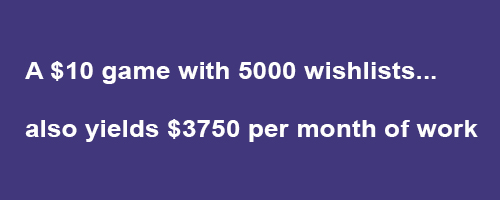
So 5K wishlists = 2500 unit sales in week 1 for $25,000 gross. That’s $15,000 net.
Over a year you could reach $125,000 gross which is $75,000 net.
Subtract your contractor costs of $30,000 and you are left with $45,000 for 12 months of work, or $3750 a month. Wow that’s the same as a $5 game with 1000 wishlists! It’s also a barely survivable amount for a full-time professional indie. You could easily earn more as a contractor.
And if you only get 1000 wishlists, then you are in trouble…
10,000 wishlists for a $15 game
OK, so you setup a studio, you hire an office for $1000 a month all in and you get in a team of four. That’s you and two artists and someone to handle the biz dev and marketing. You contract in the audio for $10000. You also spend $20000 on marketing, adverts and shows (this isn’t much, trust me). We won’t ask where you got all that upfront money from in the first place.
You pay the three team members $10K a month for two years. That $10K includes extra stuff like taxes that the company has to pay, medical, pension etc. Also don’t forget those staff will want to take vacations and may not always be 100% productive.
So that’s a total budget of:
– $10K x 3 staff x 24 months = $720K
– $10K audio
– $20K marketing
– $12K office
– TOTAL: $762K
You get 10,000 wishlists and sell 5000 units for $75,000 in week 1, and make $375,000 gross in year 1. That’s $225,000 net.
Subtract your costs of $762,000 and congratulations your business has gone bust and you never saw a penny in profit personally! In fact you lost over $500k :-O
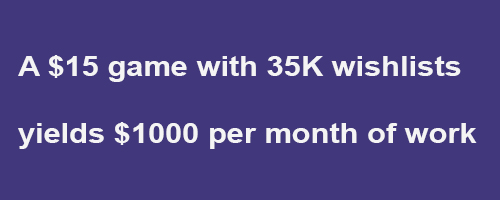
If you got 20,000 wishlists that equates to $450,000 net in year 1, which is still a loss. In fact you’d need about 34,000 wishlists to break even and 35,000 wishlists to see a tiny profit: 35,000 x 0.5 = 17,500 units in week 1 @ $15 each = $262,500. Year 1 = $262,500 x 5 = $1,312,500 gross or $787,500 net, which is $25,500 profit.
Spread over two years that earns you (the business owner) $1062 a month. Was it worth it? Also how are you going to fund your next game?
Conclusion
I’ve presented three scenarios above of different sized games and teams. I wouldn’t call any of them particularly successful and yet only a few devs will be able to even achieve that level of “success”. The sad reality is that most indies will come nowhere near.
Of course if you manage to get the numbers *just right* and your game does unusually well, then maybe you can generate a workable profit and live to fight on, you might even make it really big and get to talk at GDC.
This is the hope I cling onto anyway – perhaps foolishly – but I will keep trying for as long as I can.
I still like Steam
I’ve said it before and I’ll say it again. I’ve done OK from Steam over the years and I appreciate that they have decent tools and a giant customer base for me to sell my games to. Also they have nice people there who listen to devs and they are constantly upgrading their platform. I will continue to sell games on Steam for the foreseeable future.
However, all that doesn’t change the reality that it is still very hard to make money from selling games on Steam.